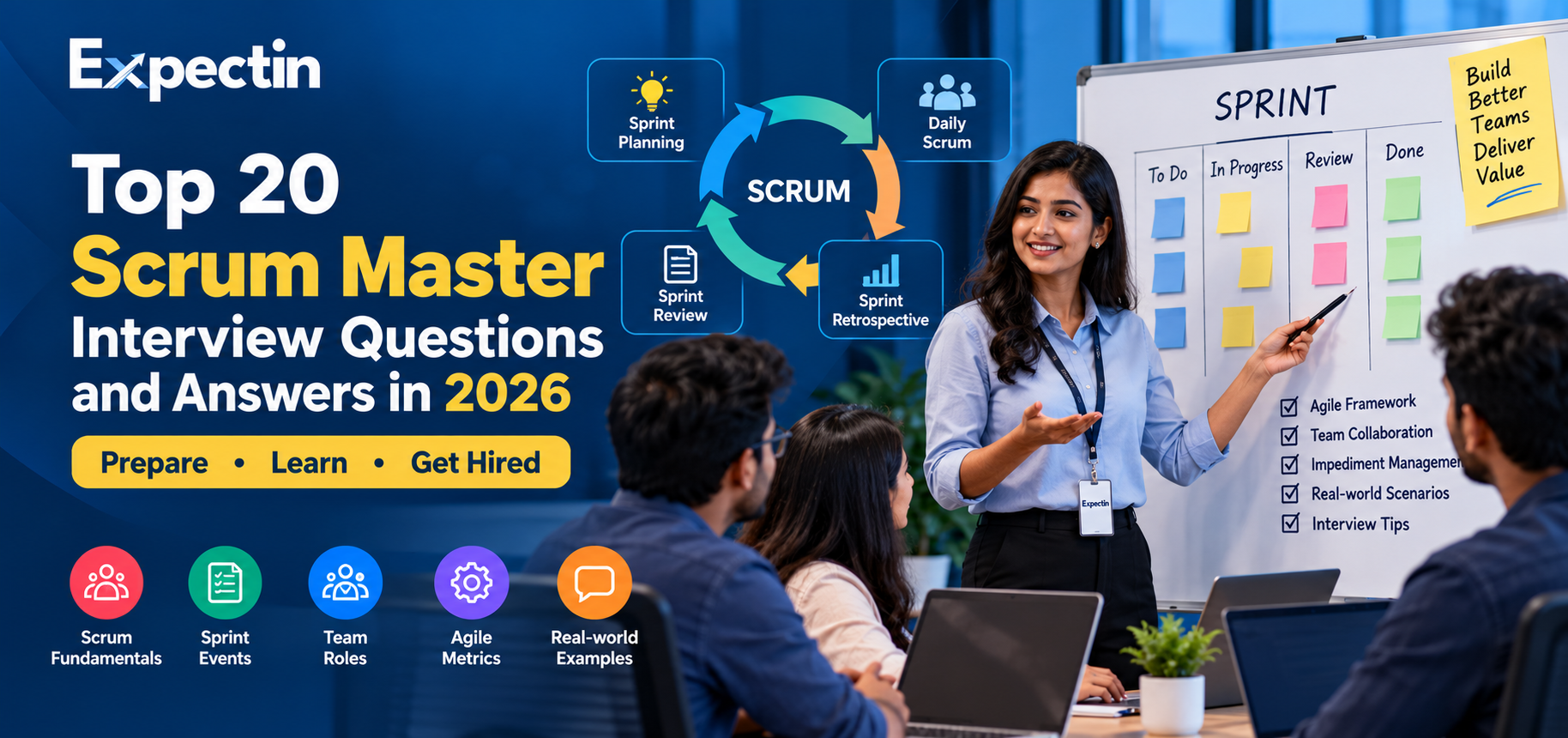
Top 20 Scrum Master Interview Questions and Answers in 2026
Scrum is a widely used framework for helping teams develop products through iterative work, regular feedback, and continuous improvement. Scrum Masters help teams understand Scrum, improve collaboration, and address obstacles that affect their progress.
If you are preparing for a Scrum Master interview, you should understand Scrum principles, team responsibilities, sprint events, and how to handle real workplace situations.
In this Expectin guide, we cover 20 common Scrum Master interview questions and sample answers to help you prepare for your next opportunity.
1. What Is Scrum?
Scrum is a lightweight framework that helps people and teams generate value through adaptive solutions for complex problems.
It organizes work into timeboxed Sprints, during which a Scrum Team works toward a Sprint Goal and produces a usable Increment.
Scrum is based on empiricism and lean thinking. Its foundations include transparency, inspection, and adaptation.
2. What Is the Role of a Scrum Master?
A Scrum Master is accountable for establishing Scrum as defined in the Scrum Guide and helping the Scrum Team and organization understand Scrum theory and practice.
Typical responsibilities include:
Coaching team members in Scrum principles and practices.
Helping the team improve collaboration and effectiveness.
Facilitating Scrum events when useful.
Helping identify and address impediments.
Supporting the Product Owner with effective product management practices.
Helping the organization adopt an effective approach to Scrum.
A Scrum Master is not simply a meeting coordinator or a traditional project manager. The role focuses on enabling the team to work effectively within Scrum.
3. What Are the Five Scrum Values?
The five Scrum values are:
Commitment
Focus
Openness
Respect
Courage
These values guide how Scrum Team members work together, make decisions, and respond to challenges.
For example, openness encourages team members to discuss risks and difficulties honestly rather than hiding problems until the end of a Sprint.
4. What Are the Accountabilities in a Scrum Team?
The Scrum Team has three accountabilities:
Developers: Create a usable Increment during each Sprint.
Product Owner: Accountable for maximizing the value of the product resulting from the work of the Scrum Team and managing the Product Backlog effectively.
Scrum Master: Accountable for establishing Scrum and improving the Scrum Team's effectiveness.
The Scrum Team is self-managing and cross-functional. It does not need a separate traditional hierarchy within the framework.
5. What Is a Sprint?
A Sprint is a fixed-length event of one month or less during which the Scrum Team works toward a Sprint Goal and produces a valuable, usable Increment.
A new Sprint begins immediately after the previous Sprint concludes.
During a Sprint, the team can adapt its plan as it learns more, provided that changes do not endanger the Sprint Goal and quality does not decrease.
6. What Is Sprint Planning?
Sprint Planning starts the Sprint by establishing why the Sprint is valuable, what can be done during it, and how the chosen work will be accomplished.
The Scrum Team collaborates on three key topics:
Why is this Sprint valuable?
What can be Done this Sprint?
How will the chosen work get done?
The resulting plan is captured in the Sprint Backlog. Sprint Planning is collaborative; the Scrum Master helps ensure that the event takes place and that participants understand its purpose.
7. What Is the Daily Scrum?
The Daily Scrum is a 15-minute event for Developers to inspect progress toward the Sprint Goal and adapt the Sprint Backlog as necessary.
It is not intended to be a status report to a manager.
A team may discuss:
Progress toward the Sprint Goal
Work that needs adjustment
Dependencies or obstacles
How to coordinate the next day's work
The Developers decide how to conduct the event, as long as it fulfills its purpose and stays within the timebox.
8. What Is a Sprint Review?
The Sprint Review is held near the end of the Sprint to inspect the outcome and determine future adaptations.
The Scrum Team and stakeholders review what was accomplished, discuss changes in the environment, and collaborate on what to do next.
It is a working session, not merely a presentation or demonstration. Feedback may influence future Product Backlog decisions.
9. What Is a Sprint Retrospective?
The Sprint Retrospective is an opportunity for the Scrum Team to inspect how the previous Sprint went in terms of people, interactions, processes, tools, and the Definition of Done.
The team identifies useful improvements and plans ways to increase quality and effectiveness.
A good retrospective creates a safe environment for honest discussion. The aim is to learn and improve, not to blame individuals.
10. What Is the Difference Between a Product Backlog and a Sprint Backlog?
Product Backlog: An evolving, ordered list of what is needed to improve the product. The Product Owner is accountable for effective Product Backlog management.
Sprint Backlog: The Sprint Goal, the set of Product Backlog items selected for the Sprint, and an actionable plan for delivering the Increment.
The Sprint Backlog is a plan by and for the Developers. It is updated as more is learned during the Sprint.
11. What Is an Impediment, and How Do You Handle It?
An impediment is an issue that obstructs or slows the team's progress.
Examples include unavailable test environments, unclear requirements, access problems, or unresolved dependencies.
A Scrum Master can help by:
Understanding the actual impact of the issue.
Working with the people involved to identify a solution.
Helping remove organizational or process obstacles.
Escalating the issue when the team cannot resolve it independently.
Following up to confirm whether progress has resumed.
The Scrum Master should encourage team ownership rather than automatically taking over every problem.
12. How Do You Handle Conflict Between Team Members?
First, understand the situation without making assumptions. Give the people involved an opportunity to explain their perspectives.
Then help them focus on the shared goal, evidence, and possible solutions.
Useful approaches include:
Active listening
Respectful, direct communication
Clarifying responsibilities and expectations
Facilitating a constructive discussion
Agreeing on specific next steps
If the conflict involves serious misconduct or a workplace safety concern, follow the organization's appropriate procedures rather than treating it as an ordinary team disagreement.
13. What Would You Do if the Team Consistently Missed Sprint Goals?
I would first work with the team to understand the reasons rather than immediately blaming individuals.
Possible causes include unclear goals, excessive work in progress, unexpected dependencies, technical debt, interruptions, or poor understanding of the work.
I would help the team inspect its planning and delivery practices, improve transparency, and identify realistic changes for the next Sprint.
The goal is to learn from the pattern and improve effectiveness, not to pressure the team into making unreliable commitments.
14. How Do You Handle Changes During a Sprint?
Changes may be necessary as new information emerges.
The Scrum Master should help the team understand that the Sprint Goal should not be endangered and quality should not decrease. The Product Owner and Developers collaborate to renegotiate the scope of the Sprint Backlog as needed.
The Product Owner can cancel a Sprint if the Sprint Goal becomes obsolete.
The Scrum Master should promote transparent discussion and adaptive planning rather than assuming that all changes are forbidden during a Sprint.
15. What Is a Definition of Done?
The Definition of Done is a formal description of the state of the Increment when it meets the quality measures required for the product.
It creates a shared understanding of the quality standards that work must meet.
Depending on the product, these standards may include code review, automated testing, security checks, documentation, and successful integration.
The Definition of Done helps prevent incomplete work from being presented as finished.
16. What Is the Difference Between Scrum and Kanban?
Scrum is a framework with defined accountabilities, events, and artifacts. Work is organized around Sprints.
Kanban is a strategy for optimizing the flow of value through a process. It emphasizes visualizing work, limiting work in progress, and managing flow.
Teams may use elements of both approaches, but they should understand the purpose and rules of each rather than combining practices without a clear reason.
17. Which Metrics Can Help a Scrum Team Improve?
Metrics should support learning and decision-making, not become tools for ranking individuals.
Useful measures may include:
Sprint Goal outcomes
Product quality and defect trends
Customer feedback
Cycle time or lead time
Work-in-progress levels
Delivery predictability
Product outcomes relevant to customers
Velocity may help a team understand its own historical delivery patterns, but it should not be used as a productivity score for comparing teams or evaluating individual employees.
18. What Is a Burndown Chart?
A burndown chart shows the remaining work over time against a planned timeline.
It can help a team visualize whether work is progressing as expected. However, a chart does not explain why progress has changed or whether the product outcome is valuable.
Teams should use charts as conversation aids alongside direct inspection of the work, Sprint Goal, quality, and emerging risks.
19. How Do You Support a Product Owner?
A Scrum Master can help the Product Owner by coaching on effective Product Backlog management, facilitating stakeholder collaboration, and supporting clear product goals.
The Scrum Master can also help the organization understand the need for clear priorities and timely decisions.
The Product Owner remains accountable for product value and effective Product Backlog management; the Scrum Master should support rather than take over those accountabilities.
20. Why Do You Want to Become a Scrum Master?
A strong answer should connect your genuine interests and experience with the responsibilities of the role.
Example:
"I am interested in helping teams collaborate effectively, solve delivery challenges, and continuously improve how they work. I enjoy facilitating discussions, making obstacles visible, and helping people focus on shared goals. I want to develop my coaching and Agile facilitation skills while supporting teams in delivering valuable products."
Customize this response to reflect your actual experience and motivations. If you are new to the role, be honest about your experience and explain how you have practised relevant skills.
Practical Tips for Scrum Master Interview Preparation
Understand Scrum, not just the terminology
Review the Scrum Guide and be able to explain the purpose of each accountability, event, artifact, and commitment.
Practise scenario-based questions
Prepare examples of how you would handle impediments, conflict, stakeholder pressure, changing priorities, and recurring delivery problems.
Demonstrate facilitation and coaching skills
Explain how you help people reach decisions and improve their own problem-solving abilities instead of simply issuing instructions.
Use real examples
If you have experience, describe the situation, your actions, the outcome, and what you learned. If you do not have professional Scrum experience, use relevant project or team experiences without presenting them as formal Scrum Master employment.
Avoid treating velocity as a target
Explain how you would use metrics to support learning and product outcomes rather than pressure teams to increase numbers.
Find Scrum Master and Agile Opportunities on Expectin
Once you have prepared for interviews, explore job listings that match your experience and skills.
Look for roles such as:
Scrum Master
Junior Scrum Master
Agile Coordinator
Agile Project Coordinator
Delivery Coordinator
Agile Coach, where your experience fits the requirements
Titles and responsibilities vary by employer. Review each job description carefully for experience requirements, Agile knowledge, certifications, location, and other eligibility criteria.
Visit https://expectin.com to explore available job opportunities and find roles aligned with your career goals.
Frequently Asked Questions
Is Scrum Master a technical role?
It depends on the organization. The core role focuses on Scrum, facilitation, coaching, and team effectiveness. Technical knowledge can be useful, especially when working with software development teams, but coding is not a universal requirement.
Can a fresher become a Scrum Master?
Some organizations offer entry-level Agile coordination or junior roles, but many Scrum Master positions require experience working with teams and Agile practices. Review the requirements carefully and build relevant facilitation experience.
Is Scrum Master the same as Project Manager?
No. A Scrum Master is accountable for establishing Scrum and improving the Scrum Team's effectiveness. A Project Manager typically has a different scope of responsibility that depends on the organization's project management approach.
Is Scrum certification mandatory?
Not every employer requires certification. Some prefer certifications such as Certified ScrumMaster (CSM) or Professional Scrum Master (PSM), while others prioritize practical experience and knowledge. Check the job description.
How can I prepare for a Scrum Master interview?
Learn the Scrum Guide, practise explaining Scrum events and accountabilities, prepare scenario-based answers, and reflect on real examples of collaboration, facilitation, and problem-solving.
Where can I find Scrum Master jobs?
Visit https://expectin.com to explore available opportunities and check the requirements for each position.
About Expectin
Expectin helps job seekers explore career opportunities and access career resources. Continue learning, practise your interview answers, and take the next step in your Agile career.