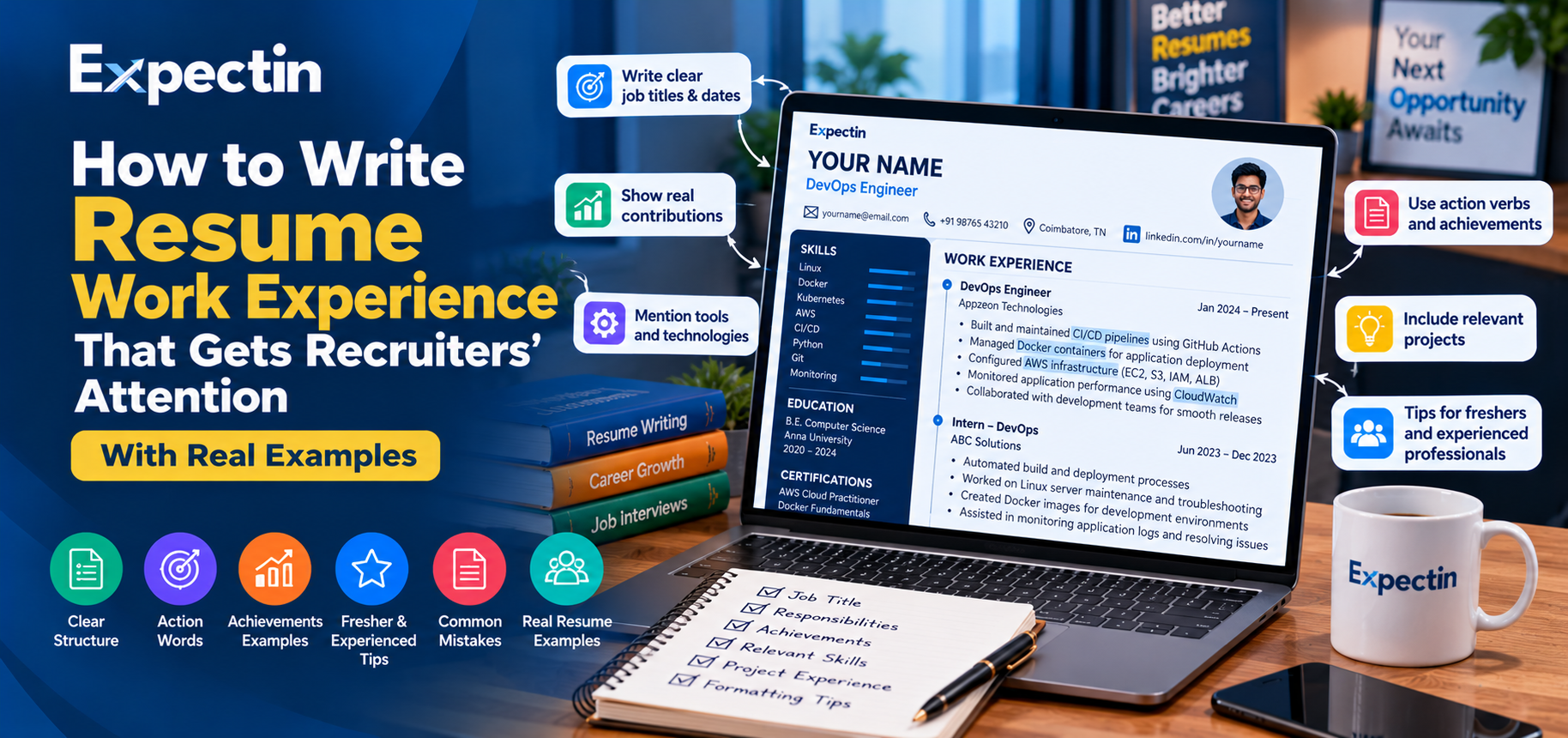
How to Write Resume Work Experience That Gets Recruiters' Attention
Your resume's work experience section is one of the first places recruiters look when evaluating your suitability for a job. They want to understand what you have done, which skills you have used, and how your experience relates to the position they are hiring for.
However, many candidates make the mistake of listing only their daily responsibilities without explaining their contributions or achievements.
A strong work experience section does not need complicated language. It needs clear descriptions, relevant details, and honest examples of your work.
In this guide, Expectin explains how freshers, experienced professionals, career switchers, and candidates returning to work can present their experience more effectively.
Why Is the Work Experience Section Important?
Recruiters often review many applications for a single vacancy. A well-organized experience section helps them quickly understand your background and assess whether you match the role's requirements.
A good work experience section should communicate:
Your previous job titles and employers
Your employment dates
Your main responsibilities
The tools, technologies, or methods you used
Relevant projects and contributions
Achievements you can explain and support
The goal is not to make every task sound impressive. It is to help recruiters understand the value of your actual experience.
1. Start With the Correct Job Title
Use your actual job title or a truthful, commonly understood equivalent.
For example:
Less clear:
Worked in the IT department.
Clearer:
Junior Software Developer
The clearer title immediately tells the recruiter which type of work you performed.
If your official title is unusual or internal to your organization, you can clarify your responsibilities in the bullet points. Do not upgrade your title to a senior position you did not hold.
2. Include Your Company Name and Employment Dates
Each work experience entry should normally include:
Job title
Company name
Employment dates
Location, when relevant
Responsibilities and achievements
Example:
Software Developer | ABC Technologies
January 2024 – Present
Developed and maintained web application features using React and Python.
Integrated REST APIs and resolved application defects.
Collaborated with developers and testers to deliver software updates.
This format makes your experience easier to scan and helps recruiters understand your career progression.
Use accurate dates and consistent formatting throughout the resume.
3. Describe What You Actually Did
Avoid vague statements that do not explain your work.
Weak example:
Responsible for application development.
Worked with the development team.
Handled project activities.
Improved example:
Developed reusable frontend components using React.
Integrated backend REST APIs and handled application errors.
Investigated defects, tested fixes, and documented technical changes.
The improved examples explain the actual work more clearly.
Use action verbs such as developed, configured, automated, implemented, analyzed, tested, maintained, and resolved when they accurately describe your contribution.
4. Highlight Achievements Instead of Listing Only Duties
Responsibilities explain what your role involved. Achievements explain what you contributed or improved.
For example:
Responsibility-focused statement:
Maintained application deployment pipelines.
Achievement-focused statement:
Improved the deployment pipeline by automating repetitive build steps and documenting the release process.
The second example communicates a specific contribution without inventing a numerical result.
If you have reliable measurements, include them where useful. For example, you might mention a verified reduction in deployment time, the number of applications supported, or the number of manual steps eliminated.
Never invent percentages, revenue figures, user counts, or performance improvements just to make your resume look stronger.
5. Use Numbers When You Can Support Them
Quantifiable achievements can help recruiters understand the scale of your work.
Examples include:
Supported 15 internal users across multiple departments.
Automated 5 recurring reporting tasks.
Reduced a recurring manual process from 30 minutes to 10 minutes, based on recorded measurements.
Managed deployment activities for 3 applications.
These are illustrative examples, not achievements to copy unless they reflect your real work.
If you cannot measure the impact, explain the result qualitatively. A truthful description is better than an impressive but unsupported number.
6. Tailor Your Work Experience to the Job Description
You do not need to rewrite your entire employment history for every application. Instead, highlight the experience most relevant to each position.
Suppose you are applying for a DevOps Engineer role that requires Linux, Docker, CI/CD, and AWS.
Relevant experience might include:
Maintained Linux-based application servers.
Created Docker images for application deployment.
Automated build and release tasks using CI/CD pipelines.
Monitored cloud resources and investigated service issues.
If you are applying for a frontend developer role, relevant experience might instead include React components, responsive interfaces, API integration, accessibility, and performance optimization.
Only include technologies and responsibilities you have genuinely worked with or can accurately describe.
7. How Freshers Can Write a Resume Without Full-Time Experience
Freshers often assume they cannot create a useful resume because they have no full-time employment history.
You can still demonstrate relevant abilities through internships, academic projects, personal projects, volunteering, freelance work, or other genuine experience.
For example:
Project Experience: Personal Expense Tracker
Built a web application to record and categorize expenses.
Developed the interface using React.
Integrated API endpoints to save and retrieve records.
Tested the application and documented setup instructions.
If the project was personal or academic, label it accordingly. Do not present it as paid employment.
For internships, include the actual organization, role, dates, and tasks you performed.
8. How Experienced Professionals Should Present Their Work
Experienced candidates should focus on relevant responsibilities, technical contributions, and progression.
Avoid listing every task you have ever completed. Prioritize achievements that demonstrate your suitability for the target position.
For example:
Backend Developer | XYZ Solutions
Developed and maintained REST APIs using Python and FastAPI.
Optimized database queries for frequently used endpoints.
Implemented automated tests to validate application behavior.
Investigated production defects and collaborated with the team on fixes.
For senior positions, highlight additional responsibilities where applicable, such as system design, technical decision-making, mentoring, incident management, and cross-team collaboration.
9. How to Explain Short-Term Jobs and Employment Gaps
Candidates sometimes worry that short employment periods or gaps will weaken their resumes.
The best approach is to present your employment history accurately and explain relevant context when appropriate.
For short-term roles:
Include the actual dates.
Explain your responsibilities and contributions.
Identify contract or internship work clearly when applicable.
For employment gaps:
Keep the timeline truthful.
Mention relevant learning, projects, caregiving, relocation, or other activities if you want to provide context.
Avoid lengthy personal explanations that are not relevant to the role.
You are not required to disclose private details that are unrelated to your professional qualifications. If asked about a gap during an interview, prepare a brief, honest explanation.
10. Use Clear Bullet Points and Consistent Formatting
Long paragraphs can make your experience difficult to scan.
Use concise bullet points that communicate one main idea each.
For example:
Instead of:
I was responsible for working on the application, communicating with the team, fixing errors, maintaining code, and helping with deployments whenever required.
Use:
Developed and maintained application features.
Investigated defects and implemented fixes.
Collaborated with teammates during testing and releases.
Use consistent verb tense. Present-tense verbs generally suit responsibilities in your current role, while past-tense verbs suit completed roles and projects.
Keep formatting consistent across job titles, company names, dates, and bullet points.
11. Common Work Experience Resume Mistakes
Copying the entire job description
A list of generic duties does not show what you actually contributed. Rewrite responsibilities in your own words and include relevant examples.
Using too much technical jargon
Technical terms are useful when relevant, but the meaning of your contribution should remain clear.
Including irrelevant responsibilities
Prioritize experience related to the target role. Older or unrelated work can often be summarized.
Claiming tools you have never used
Recruiters may ask detailed questions about any technology listed on your resume. Include only skills you can honestly explain.
Writing long paragraphs
Use concise bullet points so recruiters can scan your experience quickly.
Using vague achievement statements
Statements such as "worked hard on projects" do not explain your contribution. Describe the task, tool, or result instead.
Making unsupported claims
Do not invent performance improvements, team sizes, project outcomes, or leadership responsibilities. Your resume should accurately reflect your work.
12. Before and After: Resume Experience Examples
Here are examples showing how vague descriptions can be made more specific.
Example A: Software Developer
Before:
Worked on software development.
After:
Developed application features using JavaScript and React.
Integrated REST APIs and fixed frontend defects.
Collaborated with the team to test and release changes.
Example B: DevOps Engineer
Before:
Worked on cloud and deployment activities.
After:
Maintained application deployment pipelines using the team's CI/CD tools.
Built and managed Docker images for test environments.
Investigated deployment failures using logs and system metrics.
Example C: Technical Support Engineer
Before:
Handled customer issues.
After:
Investigated reported technical issues and documented troubleshooting steps.
Escalated complex incidents to the appropriate engineering team.
Maintained support records and communicated resolution updates.
These are examples to adapt to your actual background, not statements to copy if they do not reflect your work.
13. A Simple Checklist Before Submitting Your Resume
Review your work experience section before applying:
Are job titles, employers, and dates accurate?
Does each bullet point explain a real responsibility or contribution?
Have you highlighted experience relevant to the vacancy?
Are achievements supported by evidence?
Have you removed repetitive and vague statements?
Is the formatting consistent?
Can you confidently explain every technology and accomplishment listed?
Have you checked spelling, grammar, and readability?
A few careful edits can make your experience easier to understand without changing the facts.
Frequently Asked Questions
How many bullet points should I include for each job?
There is no universal rule. Include enough to communicate your most relevant responsibilities and contributions. Give recent and relevant roles more space than older or unrelated positions.
Should I include every job I have ever had?
Not necessarily. Include the experience most relevant to the position and maintain an accurate employment history where required. Older experience can often be summarized.
Should I write my resume in the first person?
Resume bullet points generally omit pronouns such as "I." Start with a clear action verb and describe the contribution directly.
Can freshers include personal projects under work experience?
Personal projects should normally appear in a separate Projects section rather than being presented as employment. They are still valuable evidence of practical skills.
What if I do not have measurable achievements?
Describe the task, tools used, problem addressed, and outcome where you can. Not every contribution needs a percentage or numerical result.
Should I use the same resume for every job?
Maintain a truthful master resume, then adjust the order and emphasis of relevant skills and experience for each suitable vacancy.
Final Thoughts
Your work experience section should help recruiters understand what you have done, how you work, and why your background may suit their vacancy.
Focus on accurate details, specific contributions, relevant skills, and readable formatting. Whether you are a fresher describing projects or an experienced professional highlighting technical achievements, clarity is more valuable than exaggerated claims.
Explore job opportunities on Expectin: https://expectin.com and tailor your resume to the requirements of the roles you want to pursue.
About Expectin
Expectin helps job seekers explore career opportunities and access career-related resources. Build a clear, honest resume that reflects your skills and experience, and take the next step in your career.