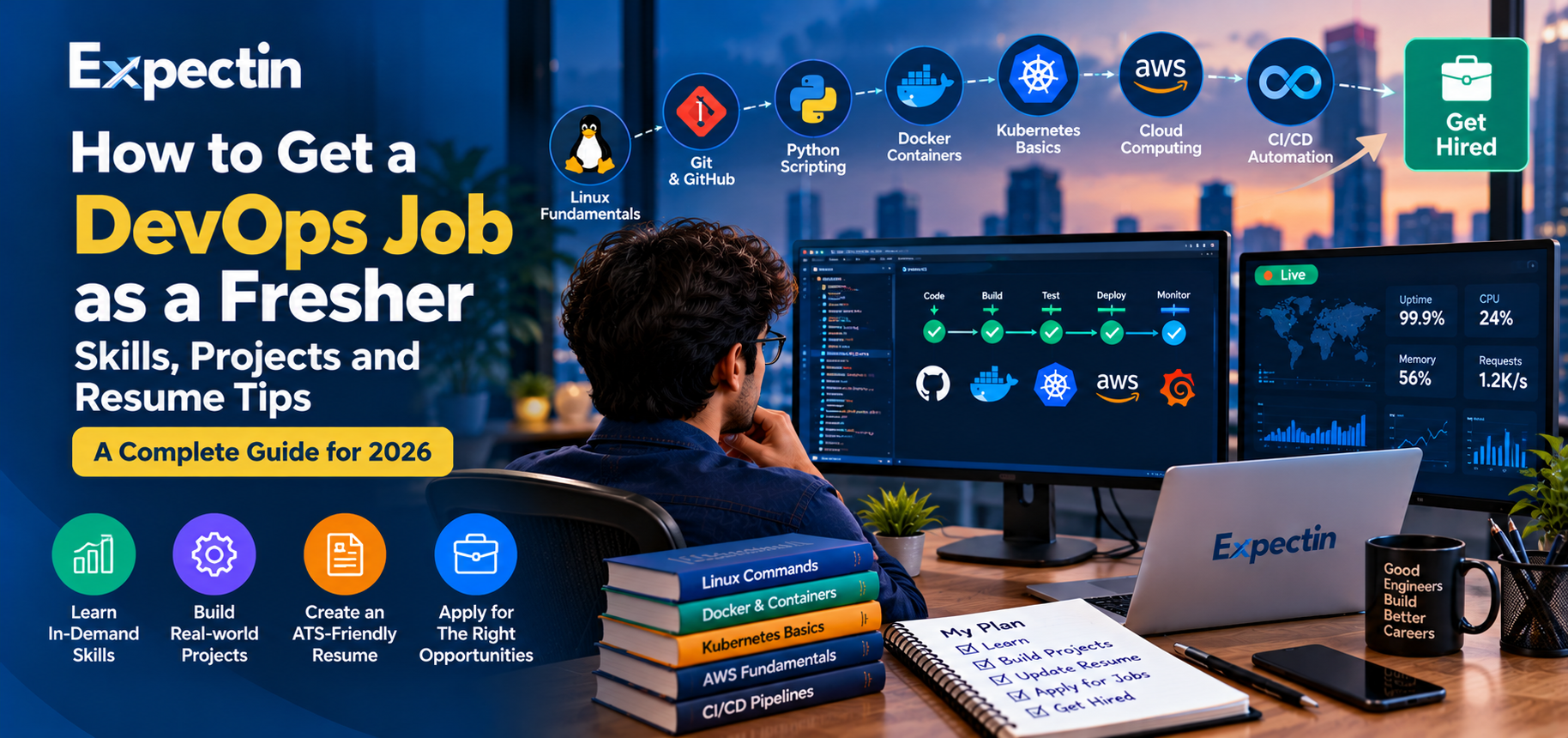
How to Get a DevOps Job as a Fresher: Skills, Projects and Resume Tips
Starting a career in DevOps can feel challenging when most job descriptions ask for practical experience. You may know Linux, Python, Docker, or cloud computing, but you might still wonder how to convince an employer that you are ready for your first role.
The good news is that you can demonstrate your abilities through practical projects, a clear resume, and consistent interview preparation.
In this guide, Expectin explains how freshers can prepare for entry-level DevOps opportunities, develop relevant skills, and improve their job applications.
What Does a DevOps Engineer Do?
A DevOps Engineer helps development and operations teams deliver software reliably and efficiently.
The role often involves automating repetitive tasks, managing infrastructure, maintaining deployment pipelines, monitoring applications, and troubleshooting production issues.
Typical responsibilities include:
Automating application build and deployment processes
Managing Linux servers and cloud infrastructure
Building and maintaining CI/CD pipelines
Working with Docker and containerized applications
Supporting Kubernetes environments where required
Monitoring application performance and availability
Managing infrastructure using code
Collaborating with developers and security teams
Responsibilities differ across organizations. Some entry-level positions focus on cloud support and automation, while others expect experience with production infrastructure.
Which Skills Should Freshers Learn?
You do not need to master every DevOps tool before applying for jobs. Focus on understanding the fundamentals and being able to demonstrate what you know.
1. Linux Fundamentals
Linux is widely used for application hosting, cloud servers, and container workloads.
Learn how to:
Navigate files and directories
Manage users, groups, and permissions
Monitor CPU, memory, and disk usage
Manage services and inspect logs
Troubleshoot network connectivity
Write basic shell scripts
Employers may ask you to explain how you would investigate a failed service, high CPU usage, or a server running out of disk space.
2. Git and Version Control
Git helps developers track changes to source code and collaborate on projects.
Practise commands such as git clone, git add, git commit, git push, git pull, and git branch.
Learn how to use GitHub or another repository platform to document your projects, maintain a useful README, and collaborate through pull requests.
3. Python or Shell Scripting
Automation is an important part of DevOps.
Python can help with API integrations, cloud automation, data processing, and operational tools. Shell scripting is useful for routine Linux administration and command-line tasks.
Start by writing small scripts that solve practical problems, such as checking disk usage, validating application endpoints, or organizing log files.
4. Docker and Containers
Docker helps package applications and their dependencies into containers.
Practise writing Dockerfiles, building images, running containers, mapping ports, managing volumes, and troubleshooting application logs.
Try containerizing a small Python or Node.js application rather than learning commands in isolation.
5. CI/CD Pipelines
Continuous Integration and Continuous Delivery or Deployment (CI/CD) help teams automate software build, test, and release processes.
Learn how a pipeline can:
Retrieve source code
Install dependencies
Run automated tests
Build a container image
Publish the image to a registry
Deploy the application to a target environment
Tools may include GitHub Actions, Jenkins, GitLab CI/CD, or other platforms depending on the employer.
6. Cloud Computing
Cloud platforms provide infrastructure and managed services for modern applications.
Choose one cloud platform to start with, such as AWS, Microsoft Azure, or Google Cloud.
For AWS-focused roles, useful foundational services include EC2, S3, IAM, VPC, CloudWatch, and Elastic Load Balancing.
Understand the purpose of each service, basic security principles, networking, and cost management before creating more complex environments.
7. Kubernetes Fundamentals
Kubernetes manages containerized applications across a cluster.
For roles that require Kubernetes, learn Pods, Deployments, Services, ConfigMaps, Secrets, namespaces, health probes, and basic troubleshooting.
You do not need advanced cluster-administration knowledge for every entry-level position. Check the requirements of the roles you intend to apply for.
8. Monitoring and Troubleshooting
DevOps engineers need to identify problems and understand why applications fail.
Learn how to inspect logs, interpret resource metrics, check service health, and distinguish application issues from infrastructure or networking problems.
Tools may include CloudWatch, Prometheus, Grafana, and the logging platforms used by a particular organization.
Build Projects That Demonstrate Your Skills
A practical project can help an employer understand how you apply technical concepts. Focus on a few complete projects rather than many unfinished tutorials.
Project 1: Automate an Application Deployment
Build a small web application and create a pipeline that tests the code and deploys it to a test environment.
Document the workflow, required configuration, deployment process, and how you handle failed builds.
Project 2: Containerize an Application
Create a Docker image for a simple application and publish it to a container registry.
Explain how you configured the image, managed dependencies, exposed application ports, and reviewed container logs.
Project 3: Deploy an Application on a Cloud Platform
Deploy a small application on a cloud service using suitable network and security settings.
Demonstrate how you configured access, enabled HTTPS where appropriate, collected logs, and monitored the application.
Keep the project within a budget you can afford. Review current service pricing, set cost alerts, and remove unused resources.
Project 4: Create a Monitoring and Alerting Setup
Configure monitoring for a test application or server.
Create a dashboard showing useful metrics and configure an alert for a meaningful failure or threshold.
Include an example of how you investigated and resolved a test issue.
How to Create a Strong DevOps Resume
Your resume should make it easy for recruiters to identify your skills, projects, and relevant experience.
Include a focused professional summary
Explain your current skill level and the areas you have practised. Avoid claiming professional experience you do not have.
Example:
"Entry-level DevOps candidate with hands-on project experience in Linux, Git, Docker, CI/CD automation, Python scripting, and AWS fundamentals. Interested in building reliable deployment workflows and improving application operations."
Adapt this summary to match your actual skills.
List relevant technical skills
Group your skills into clear categories, such as:
Operating Systems: Linux
Programming and Scripting: Python, Bash
Version Control: Git, GitHub
Containers: Docker
CI/CD: GitHub Actions or Jenkins
Cloud: AWS or another platform you have practised
Monitoring: Tools you have actually used
Only include tools you can explain in an interview.
Describe projects with specific outcomes
Instead of writing "Learned Docker," explain what you built and how it worked.
For example:
"Containerized a Python web application using Docker, configured environment variables, and documented build and deployment steps in GitHub."
If you have measurable results, include them only when you can substantiate them.
Keep the resume readable
Use clear headings, consistent formatting, and concise bullet points. Include links to relevant repositories or project demonstrations when available.
Avoid unnecessary graphics, keyword stuffing, fabricated achievements, and unsupported claims.
How to Prepare for a DevOps Interview
Interview preparation should include both technical knowledge and practical problem-solving.
Review fundamentals: Be ready to explain Linux processes, file permissions, Git workflows, Docker images, cloud networking, and CI/CD concepts.
Practise troubleshooting: Prepare to investigate a failed deployment, a container that keeps restarting, a full disk, or an application that cannot connect to a service.
Explain your projects: Describe the problem, architecture, tools, implementation, challenges, and lessons learned.
Practise scenario-based questions: Explain your reasoning step by step. If you do not know the answer, state your assumptions and describe how you would investigate the issue.
Prepare for communication questions: DevOps work often involves collaboration, incident reporting, documentation, and coordinating changes with other teams.
Where Can Freshers Find DevOps Jobs?
Look for job titles such as:
Junior DevOps Engineer
DevOps Trainee
Cloud Support Associate
Junior Cloud Engineer
Infrastructure Support Engineer
Build and Release Engineer
Technical Operations Engineer
Some companies advertise entry-level positions without using the word "fresher" in the title.
Read each job description carefully. Check the experience requirement, location, work mode, required skills, and eligibility criteria before applying.
You can explore available opportunities on Expectin: https://expectin.com.
Review the requirements for each vacancy and tailor your resume to the skills that genuinely match your background.
Common Mistakes Freshers Should Avoid
Learning too many tools at once
Trying to learn every cloud service, container platform, and automation tool can prevent you from developing strong fundamentals. Focus on the skills most relevant to your target jobs.
Copying projects without understanding them
A project is useful only when you can explain how it works, why you selected particular tools, and how you would troubleshoot it.
Applying with the same resume everywhere
Highlight the relevant skills and projects for each role without misrepresenting your experience.
Ignoring Linux and networking
DevOps tools rely on operating systems, networking, permissions, and application behavior. Understanding these fundamentals makes troubleshooting easier.
Waiting until you know everything
You can begin applying when you meet the essential requirements of suitable entry-level roles. Continue learning while you apply and improve your portfolio.
Final Thoughts
Getting your first DevOps job is not about collecting the largest number of tools or certifications. It is about developing relevant fundamentals, applying them through practical projects, communicating what you have learned, and applying consistently to suitable positions.
Start with a manageable project, document your work, build a clear resume, and prepare to explain your decisions during interviews.
Explore career opportunities on Expectin at https://expectin.com and take the next step toward your IT career.
About Expectin
Expectin helps job seekers explore career opportunities and access career-related resources. Continue building practical skills, strengthen your resume, and keep looking for opportunities that match your experience.