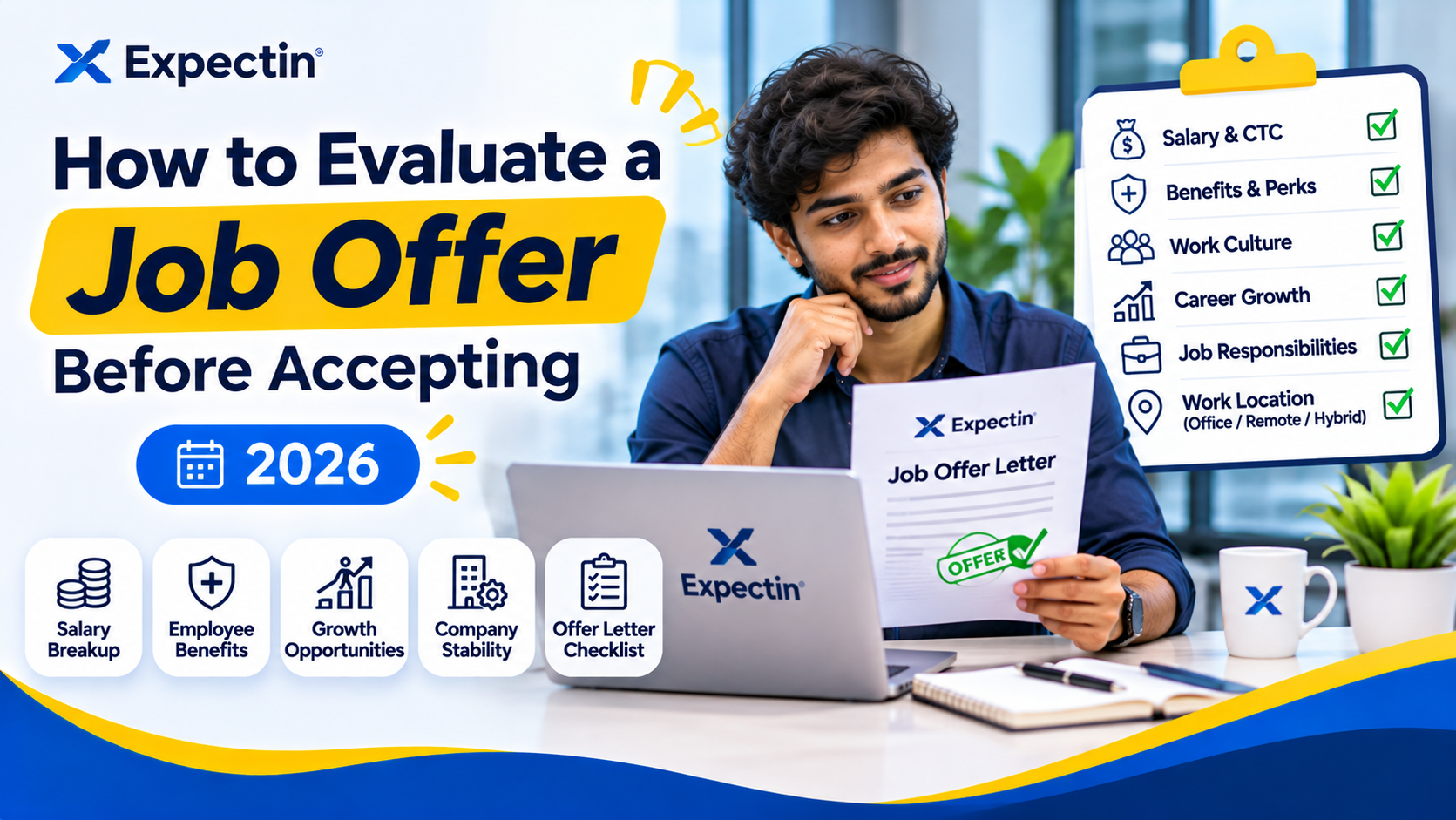
How to Evaluate a Job Offer Before Accepting: Salary, Benefits, Work Culture and Career Growth in 2026
Receiving a job offer is an exciting milestone in your professional journey. After attending interviews, completing assessments and waiting for recruiter updates, finally getting selected can feel like a major achievement.
However, accepting a job offer is an important career decision that deserves careful consideration.
Many candidates focus only on the salary mentioned in the offer letter and overlook other important factors such as job responsibilities, working conditions, employee benefits, career growth and company stability.
Whether you are a fresher accepting your first job or an experienced professional planning a career move, understanding how to evaluate an offer can help you make a better decision.
In this guide, we will explain 10 important factors to consider before accepting a job offer in 2026.
1. Understand the Complete Salary Structure
Salary is one of the first things candidates evaluate when receiving an offer.
However, do not make your decision based only on the total Cost to Company (CTC).
Ask the recruiter for a detailed compensation breakup.
Understand the following components:
Basic salary.
House Rent Allowance (HRA).
Special allowances.
Employer Provident Fund contribution.
Variable pay.
Performance bonuses.
Gratuity, where applicable.
Other applicable benefits and deductions.
Understand CTC vs In-Hand Salary
CTC represents the overall annual cost incurred by an employer for employing you.
In-hand salary is the amount you actually receive after applicable deductions.
For example, two companies may offer the same annual CTC but provide different monthly take-home salaries because their compensation structures differ.
Before accepting an offer, ask HR for an estimated monthly salary breakup.
2. Evaluate the Job Responsibilities
A good salary does not necessarily mean the job is suitable for your career.
Carefully review the responsibilities mentioned in the offer and job description.
Ask yourself:
Does the position match my professional skills?
Will I get opportunities to learn new technologies?
Are the responsibilities clearly defined?
Does the role align with my career goals?
Will I have opportunities to take ownership of projects?
For example, a DevOps Engineer position might involve:
Managing AWS infrastructure.
Building CI/CD pipelines.
Automating infrastructure using Terraform.
Managing Docker containers.
Working with Kubernetes.
Monitoring production applications.
Understand whether the actual responsibilities match the position discussed during your interviews.
3. Research the Company's Reputation and Stability
Before joining an organization, understand its background.
Research:
Company website.
Business model.
Products and services.
Industry presence.
Recent company developments.
Employee feedback.
Professional leadership team.
Check whether the company has a clear business operation and whether the position is genuinely available.
For startups, understand their business stage, funding situation where publicly available, customer base and business sustainability.
Remember that online employee reviews represent individual experiences and should not be treated as the complete picture.
4. Understand Employee Benefits and Perks
Compensation is not limited to monthly salary.
Different organizations provide different employee benefits.
Check whether the company offers:
Health insurance.
Paid annual leave.
Sick leave.
Provident Fund.
Gratuity.
Performance bonuses.
Internet or travel allowances.
Learning and development programs.
Parental leave.
Flexible working arrangements.
Understand which benefits are included in the offer and which are subject to company policy.
These benefits can make a significant difference to your overall employment experience.
5. Evaluate Work Culture and Work-Life Balance
A healthy work environment can contribute to long-term career satisfaction.
Before accepting the offer, try to understand the company's working culture.
Consider:
Working hours.
Weekend working requirements.
Team collaboration.
Management style.
Communication practices.
Employee development.
Leave policies.
Remote working flexibility.
You can ask the recruiter or hiring manager about the team's working environment during the final discussion.
For technical positions, understand whether the role involves production support, rotational shifts, on-call responsibilities or incident management.
Make sure these expectations are clearly communicated.
6. Understand the Work Location and Remote Policy
Work location is another important factor.
Companies may offer:
Work from Office: Employees are expected to work from the company's office.
Work from Home: Employees can perform their responsibilities remotely, subject to company policy.
Hybrid Work: Employees divide their working time between the office and remote locations.
Before accepting the offer, clarify:
Office location.
Expected joining location.
Work-from-home policy.
Hybrid attendance requirements.
Relocation support.
Travel requirements.
Shift timings.
Consider your commuting time and additional expenses when comparing offers.
7. Check the Probation Period and Notice Period
Employment conditions are important parts of your offer letter.
Understand the following:
Probation Period
A probation period is an initial employment period during which the employer evaluates your performance and suitability.
Check:
Probation duration.
Confirmation process.
Performance expectations.
Benefits during probation.
Applicable termination conditions.
Notice Period
The notice period is the required period of advance notice when an employee or employer ends employment, subject to the applicable contract and law.
Check:
Notice period duration.
Notice period during probation.
Notice period after confirmation.
Buyout provisions, if applicable.
Applicable exit procedures.
Read these conditions carefully before signing the offer.
8. Evaluate Career Growth and Learning Opportunities
Your first job or next career move should support your long-term professional development.
Consider whether the organization provides:
Technical training.
Professional certifications.
Mentorship.
Internal promotions.
Opportunities to work on different projects.
Leadership development.
Exposure to new technologies.
For freshers, learning opportunities can be particularly important.
For experienced professionals, consider whether the role offers greater responsibility, specialization or leadership opportunities.
A position that helps you develop valuable skills may offer long-term benefits beyond the initial salary.
9. Compare Multiple Job Offers Before Making a Decision
If you receive multiple offers, compare them carefully instead of selecting the one with the highest CTC.
Consider the following example:
| Factor | Company A | Company B |
|---|---|---|
| Annual CTC | ₹5 LPA | ₹6 LPA |
| Role | Junior Developer | Software Developer |
| Work mode | Office | Hybrid |
| Learning opportunities | Moderate | Strong |
| Variable pay | Included | Not included |
| Commute | Longer | Shorter |
This is an illustrative comparison. Actual compensation and employment conditions should be verified from each offer.
The best offer depends on your financial needs, career goals, responsibilities and personal preferences.
Do not make decisions based on salary alone.
10. Read the Offer Letter Carefully Before Signing
The offer letter is an important employment document.
Before accepting, verify:
Your full name.
Job designation.
Department.
Annual compensation.
Salary breakup.
Joining date.
Work location.
Employment type.
Probation period.
Notice period.
Applicable policies.
Special employment conditions.
If anything is unclear, request written clarification from HR.
Never assume that verbal promises automatically form part of your written employment terms.
Keep a copy of the final signed offer letter for your records.
11. Questions to Ask HR Before Accepting a Job Offer
Asking relevant questions demonstrates that you are making an informed career decision.
Here are some useful questions:
What will be my primary job responsibilities?
What is the complete CTC and monthly salary breakup?
Is any part of the salary variable?
What benefits are included?
What is the probation period?
What is the notice period?
What are the regular working hours?
Are there rotational shifts or weekend responsibilities?
What is the company's work-from-home policy?
What are the opportunities for professional growth?
What is the expected joining date?
What is the process for performance reviews?
You do not need to ask every question in one conversation. Prioritize the areas that are important to your decision.
12. Common Mistakes to Avoid Before Accepting a Job
Avoid these mistakes when evaluating a job offer:
Accepting an offer without reviewing the salary breakup.
Focusing only on annual CTC.
Ignoring the notice period.
Not checking the actual job responsibilities.
Assuming all promised benefits are guaranteed.
Ignoring work location and commuting expenses.
Not understanding variable compensation.
Signing documents without reading the terms.
Making decisions based only on verbal promises.
Resigning from your current job before receiving and reviewing the formal offer.
Take sufficient time to understand the opportunity before making your decision.
13. What Should You Do If You Want to Negotiate the Job Offer?
If the compensation or employment conditions do not match your expectations, you can have a professional discussion with HR.
For example:
"Thank you for extending the offer. I am excited about the opportunity and interested in joining your organization. After reviewing the responsibilities and compensation structure, I would like to discuss whether there is flexibility in the offered package. I would appreciate the opportunity to explore a mutually suitable arrangement."
You can discuss:
Fixed compensation.
Variable pay.
Joining bonus.
Additional benefits.
Joining date.
Performance review timeline.
Always communicate respectfully and base your expectations on reasonable market research and your qualifications.
Final Thoughts
Accepting a job offer is more than just choosing a salary package. It is a decision that can influence your professional growth, financial stability and overall career satisfaction.
Before accepting, evaluate the compensation structure, responsibilities, company reputation, benefits, work culture and future opportunities.
Take time to read the offer letter, clarify your doubts and compare available options.
A well-informed decision today can help you build a stronger career tomorrow.
Looking for your next career opportunity?
Explore job opportunities, create your professional profile and discover career resources with Expectin.
Visit: https://expectin.com
Frequently Asked Questions (FAQs)
1. What should I check before accepting a job offer?
Review the salary breakup, job responsibilities, company reputation, employee benefits, working hours, location, probation period and notice period.
2. Should I accept a job offer with a higher CTC?
Not necessarily. Compare fixed salary, variable pay, benefits, job responsibilities, work culture and career growth before making a decision.
3. Can I negotiate my salary after receiving an offer letter?
Yes. You can professionally discuss compensation and other employment conditions with HR before accepting the offer.
4. What is the difference between CTC and in-hand salary?
CTC represents the overall annual employment cost, whereas in-hand salary is the amount credited to your bank account after applicable deductions.
5. Is it important to check the probation period?
Yes. Understand its duration, confirmation criteria, benefits and applicable employment conditions before joining.
6. Should freshers prioritize salary or learning opportunities?
Both are important. Freshers should consider compensation alongside practical exposure, training, mentorship and opportunities to develop valuable professional skills.
7. Can I reject a job offer after receiving it?
Yes. You can professionally decline an offer before joining. Review any documents already signed and applicable contractual obligations before making your decision.
8. How much time should I take to accept a job offer?
Follow the deadline provided by the employer. If you need additional time, politely request an extension rather than missing the deadline without communication.