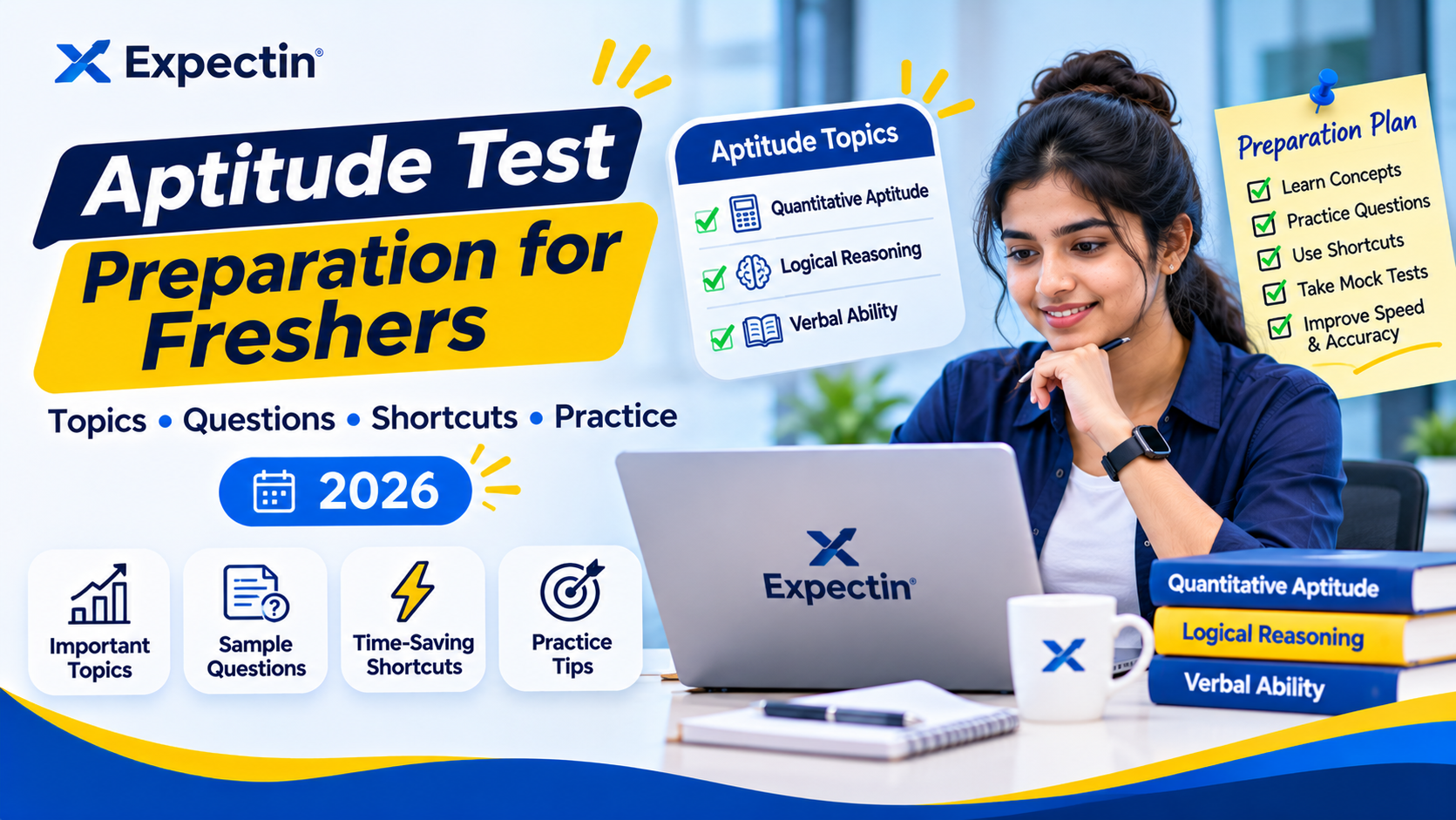
Aptitude Test Preparation for Freshers: Topics, Questions, Shortcuts and Practice Tips for 2026
Are you preparing for campus placements, IT company recruitment or your first job? One of the common challenges freshers face during recruitment is the aptitude test.
Many companies use aptitude assessments to evaluate candidates' numerical ability, logical thinking, problem-solving skills and communication abilities.
Even if you have strong technical knowledge, performing poorly in an aptitude test can affect your chances of progressing to the next recruitment round.
The good news is that aptitude tests can be improved through consistent practice, proper preparation and effective time management.
In this guide, we will cover important aptitude topics, sample questions, shortcuts and preparation strategies for freshers in 2026.
1. What Is an Aptitude Test?
An aptitude test is an assessment used by employers to evaluate a candidate's ability to solve problems, understand information and think logically.
Companies commonly include aptitude tests as part of their recruitment process.
These assessments help employers evaluate:
Numerical ability.
Logical reasoning.
Analytical thinking.
Verbal communication.
Problem-solving skills.
Time management.
Accuracy.
Aptitude tests are commonly conducted during campus placements, IT recruitment, graduate hiring and other competitive selection processes.
2. Important Aptitude Topics You Should Prepare
Most placement aptitude tests cover three major areas.
A. Quantitative Aptitude
Quantitative aptitude evaluates your ability to solve mathematical problems.
Important topics include:
Percentages.
Profit and Loss.
Simple and Compound Interest.
Time and Work.
Time, Speed and Distance.
Ratio and Proportion.
Average.
Number Systems.
Probability.
Permutations and Combinations.
Problems on Ages.
Mixtures and Alligations.
Data Interpretation.
Partnership.
Pipes and Cisterns.
Start with basic mathematical concepts before moving towards advanced problems.
B. Logical Reasoning
Logical reasoning evaluates how effectively you identify patterns and solve analytical problems.
Important topics include:
Number Series.
Alphabet Series.
Coding and Decoding.
Blood Relations.
Direction Sense.
Seating Arrangements.
Syllogisms.
Statement and Conclusion.
Puzzles.
Analogy.
Classification.
Ranking and Ordering.
Data Sufficiency.
Logical Sequences.
Practice different question formats to improve your problem-solving speed.
C. Verbal Ability
Verbal ability evaluates your understanding of the English language.
Important topics include:
Reading Comprehension.
Synonyms and Antonyms.
Sentence Correction.
Error Detection.
Fill in the Blanks.
Para Jumbles.
Sentence Completion.
Vocabulary.
Grammar.
Active and Passive Voice.
Regular reading and grammar practice can help improve your verbal ability.
3. Important Quantitative Aptitude Questions With Answers
Here are some sample questions to help you understand common placement aptitude problems.
Question 1: Percentage
A candidate scored 360 marks out of 450. What is the percentage?
Solution:
Percentage = (Obtained Marks / Total Marks) × 100
= (360 / 450) × 100
= 80%
Answer: 80%
Question 2: Profit and Loss
A product is purchased for ₹800 and sold for ₹1,000. Calculate the profit percentage.
Solution:
Profit = Selling Price − Cost Price
= 1,000 − 800
= ₹200
Profit Percentage = (Profit / Cost Price) × 100
= (200 / 800) × 100
= 25%
Answer: 25%
Question 3: Average
The average of five numbers is 20. What is their total?
Solution:
Average = Total / Number of Values
Total = Average × Number of Values
= 20 × 5
= 100
Answer: 100
Question 4: Time and Work
A person can complete a task in 10 days. How much of the work can the person complete in one day?
Solution:
One day's work = 1 / Total Days
= 1 / 10
Answer: 1/10 of the work
Question 5: Ratio
The ratio of two numbers is 2:3. If their total is 50, find the numbers.
Solution:
Total ratio = 2 + 3 = 5
One part = 50 / 5 = 10
First number = 2 × 10 = 20
Second number = 3 × 10 = 30
Answer: 20 and 30
4. Important Logical Reasoning Questions With Answers
Question 1: Number Series
Find the next number:
2, 4, 8, 16, 32, ?
Solution:
Each number is multiplied by 2.
32 × 2 = 64
Answer: 64
Question 2: Alphabet Series
Find the next letter:
A, C, E, G, ?
Solution:
The sequence skips one letter each time.
A → C → E → G → I
Answer: I
Question 3: Direction Sense
A person walks 5 km north and then 3 km east. In which direction is the person from the starting point?
Solution:
The person moves north and then east.
Therefore, the final direction is North-East.
Answer: North-East
Question 4: Coding and Decoding
If CAT is written as DBU, how is DOG written using the same pattern?
Solution:
Each letter is shifted forward by one position.
D → E
O → P
G → H
Answer: EPH
Question 5: Odd One Out
Find the odd one out:
Apple, Mango, Banana, Carrot.
Solution:
Apple, Mango and Banana are commonly classified as fruits.
Carrot is a vegetable.
Answer: Carrot
5. Important Verbal Ability Questions With Answers
Question 1: Synonym
Choose the synonym of "Rapid".
A. Slow
B. Fast
C. Weak
D. Late
Answer: B. Fast
Question 2: Antonym
Choose the opposite of "Expand".
A. Increase
B. Extend
C. Reduce
D. Develop
Answer: C. Reduce
Question 3: Fill in the Blank
She _____ to the office every day.
A. Go
B. Goes
C. Going
D. Gone
Answer: B. Goes
Question 4: Identify the Correct Sentence
A. He don't like coffee.
B. He doesn't likes coffee.
C. He doesn't like coffee.
D. He not like coffee.
Answer: C. He doesn't like coffee.
Question 5: Vocabulary
What does the word "Reliable" mean?
A. Trustworthy
B. Careless
C. Uncertain
D. Weak
Answer: A. Trustworthy
6. Best Shortcuts to Improve Aptitude Test Speed
Time management is an important part of aptitude assessments.
Here are some useful techniques.
Percentage Shortcuts
Remember these common conversions:
10% = 1/10
20% = 1/5
25% = 1/4
50% = 1/2
75% = 3/4
12.5% = 1/8
These conversions can help simplify percentage calculations.
Multiplication Shortcuts
Practice multiplication tables up to 20.
Also learn squares up to 30 and commonly used cubes.
These can help you solve numerical questions faster.
Number Series
Instead of guessing the next number, check:
Addition or subtraction patterns.
Multiplication or division patterns.
Square and cube patterns.
Alternating sequences.
Time Management
Do not spend too much time on a single question.
If a problem appears difficult, move to another question and return later if time permits.
7. How to Prepare for IT Company Aptitude Tests
Many IT companies use aptitude assessments as part of their fresher recruitment process.
Preparation should include:
Quantitative aptitude.
Logical reasoning.
Verbal ability.
Basic programming concepts.
Technical fundamentals.
Problem-solving exercises.
Depending on the company and role, recruitment assessments may also include coding challenges, communication assessments or domain-specific questions.
Research the specific recruitment pattern before preparing.
8. A 30-Day Aptitude Preparation Plan for Freshers
A structured study plan can help you prepare consistently.
Week 1: Quantitative Aptitude
Focus on:
Percentages.
Profit and Loss.
Average.
Ratio and Proportion.
Time and Work.
Number Systems.
Practice at least 20 questions daily.
Week 2: Logical Reasoning
Focus on:
Number Series.
Coding and Decoding.
Blood Relations.
Direction Sense.
Seating Arrangements.
Puzzles.
Practice different question patterns every day.
Week 3: Verbal Ability
Focus on:
Grammar.
Vocabulary.
Reading Comprehension.
Sentence Correction.
Synonyms and Antonyms.
Para Jumbles.
Spend time reading English articles and practicing grammar exercises.
Week 4: Mock Tests and Revision
Focus on:
Full-length aptitude tests.
Previous placement questions.
Time management.
Accuracy improvement.
Revising difficult topics.
Review your mistakes after every mock test.
9. Common Mistakes to Avoid During Aptitude Tests
Avoid these mistakes:
Starting the test without reading the instructions.
Spending too much time on difficult questions.
Guessing answers without considering negative marking.
Ignoring basic mathematical concepts.
Practicing without tracking mistakes.
Not attempting mock tests.
Ignoring verbal ability.
Rushing through questions and making calculation errors.
Failing to manage the available time.
Preparing only one section of the assessment.
Balanced preparation is essential for improving your overall performance.
10. Best Ways to Practice Aptitude Questions Online
You can improve your preparation through:
Online aptitude practice platforms.
Previous placement question papers.
Mock assessment websites.
Quantitative aptitude books.
Logical reasoning exercises.
Daily English reading.
Timed practice tests.
Try to practice consistently rather than studying everything just before an assessment.
11. How to Build Confidence Before a Placement Test
Confidence improves when you understand the question patterns and practice regularly.
Follow these recommendations:
Start with basic-level questions.
Gradually increase difficulty.
Maintain a record of incorrect answers.
Revise formulas regularly.
Take timed mock tests.
Avoid comparing your preparation with others.
Get sufficient rest before the assessment.
Remember that accuracy and logical thinking are just as important as speed.
Final Thoughts
Aptitude tests are an important part of many fresher recruitment and campus placement processes.
Preparing for quantitative aptitude, logical reasoning and verbal ability can help you approach assessments with greater confidence.
Start with the fundamentals, practice sample questions, follow a structured study plan and regularly evaluate your performance through mock tests.
Consistent preparation can help you improve your speed, accuracy and problem-solving abilities.
Prepare for your next job opportunity with Expectin!
Explore job opportunities, create your candidate profile and take the next step towards your career goals.
Website: https://expectin.com
Frequently Asked Questions (FAQs)
1. What are the most important aptitude topics for freshers?
Important topics include percentages, profit and loss, averages, ratios, time and work, number series, coding and decoding, logical reasoning and verbal ability.
2. How many days are required to prepare for an aptitude test?
It depends on your current knowledge and the difficulty of the assessment. A structured 30-day preparation plan can provide a useful starting point.
3. Are aptitude tests compulsory for IT company placements?
Many IT companies include aptitude assessments in their recruitment processes, but the selection pattern varies by company and job role.
4. How can I improve my aptitude calculation speed?
Practice mathematical shortcuts, memorize common formulas, revise multiplication tables and solve timed exercises regularly.
5. Can freshers clear aptitude tests without coaching?
Yes. Freshers can prepare independently using aptitude books, online practice resources, sample questions and mock assessments.
6. Which is more important: speed or accuracy?
Both are important. Focus on answering correctly within the available time rather than rushing through questions.
7. Should I practice aptitude questions every day?
Daily practice is beneficial because it helps strengthen problem-solving skills, improve calculation speed and identify weak areas.
8. What should I do if I cannot solve an aptitude question?
Avoid spending too much time on one question. Move to another question and return to the difficult one later if the test allows it.